
Canker is probably the most difficult disease faced by apple growers World Wide.
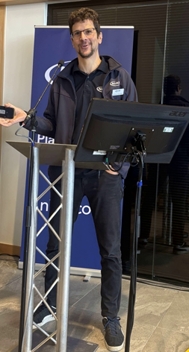
Below: Dr Mat Papp-Rupar, Plant Pathologist Project Leader NIAB
 While many pests and diseases challenge the production of clean healthy fruit, most can be dealt with either by a chemical spray or more environmentally friendly means. Canker has at this moment in time, no weapon, either chemically or otherwise, capable of efficiently killing the spores which are the first enemy of infection!
Containment is currently the only means of keeping canker in check. Over the years we (fruit growers and scientists) would get excited by some new canker strategy. But it is still the number one global challenge.
In a recent presentation Dr Mat Papp-Rupar, Plant Pathologist Project Leader NIAB gave the most comprehensive overview of the history of global battle against apple canker.
Containment is the only practical way of dealing with canker!
Before we review Mat's Canker presentation, I am including a passage from my Journal in 2020 which reviews a canker research update.
Research - The ongoing research for controlling canker has been going on for decades, with 'every so often' a new breakthrough or more accurately 'a better understanding of the canker beast' surfacing. As a grower, I like many was convinced the infection came from the nursery as the 'source of infection' and no doubt that was true in some cases. We know an orchard which has suffered severe canker in the past is the last place to plant a canker susceptible variety. Today we recognise the importance of orchard hygiene; the removal of overwintering canker spores on any pruning's left in the orchard is a 'launch pad' for canker in the next growing season. Pruning in wet weather creates a high risk of spreading infection from one cut surface to another. Leaf abscission when canker spore are prevalent (wet & humid conditions) is another danger zone!
For the full EAM review from February 2020. Click on: Canker - the number 1 challenge for apple growers
Mat spelt out the challenges of Canker, examined the attempts to kill canker at source, but emphasised the only way to stop canker destroying your trees/orchards is with practical containment actions.
A whole orchard approach to managing apple canker
Agenda
* Canker management overview
* Soil physical and chemical properties linked to canker severity?
* Soil beneficial microbes reducing canker impacts in the orchard?
* Take home messages and question
(European) Apple canker
* Caused by fungal pathogen Neonectria ditissima
* Worldwide distribution - all apple growing regions
* Broad host range: Malus, Pyrus, Acer, Fagus, Prunus, Sorbus, Quercus,....
* Conidia and ascospores infecting wounds:
* Branch dieback / Killing trees newly planted orchards- up to 30% of
* Reducing yield, quality and orchard longevity
* Causing postharvest fruit rot
Apple canker - management challenge
* Inoculum and wounds present all year around
* Manmade: Pruning wounds / Picking wounds / ...
* Natural: Petal scars/ Growth cracks / Lenticels / Leaf scars / ...
* In UK climate: 1 canker in orchard will result in 100% trees with canker after 6-7 years if left completely unmanaged
* Commercial apple cultivars are highly susceptible.
* Variation in susceptibility (Gala, Jazz > Braeburn > Golden delicious)
* High density of planting
* Often ineffective chemical products
* Difficult to target sporulation / wound protection
* Product removal
* No effective biocontrol products
* Inoculum removal in the most effective, expensive and labour intensive
* Multi-locus, quantitative canker resistance (GxE, tissue/age specific)
* No major R-genes; challenging breeding of resistant varieties
In the slides below, Matt illustrates the effect of canker spores in a tree and the benefit of limited canker in an orchard helping keep canker under control.
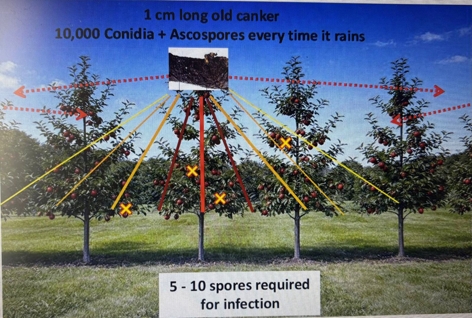 Inoculum removal for canker management
* YOU CAN NOT SPRAY CANKER AWAY
* No spray can kill canker lesions or stop them sporulating
* 1 mm of canker = 1000 potential infections
* Leaf scar protection is possible with Captan/Tebuconazole only if:
* Good coverage / high water volumes (800-1000l/ha); AND
* Timed correctly (20, 50 80% leaf fall) - orchard access / ground; AND
* Low inoculum load AND fungicide availability
* Scab sprays may partly control petal scar infections
* Picking and pruning wounds are impossible to target and protect
* Experiments in NZ commercial orchards:
* Double the spray effort; reducing the rate of canker spread
* The same % of trees with canker
* Double the pruning efforts; reducing canker prevalence
* Cleaner orchard with less cankers
Protection with spraying
only - canker not removed:-Spray fungicide after every rain event
* Products?- Cover all wounds:
* Pruning wounds, Petal scars, Growth cracks, Lenticels, Picking wounds, Leaf scars
* Continuous battle
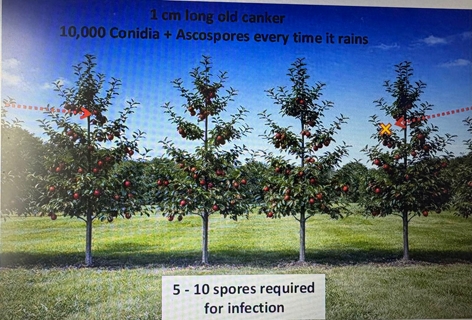
 Cankers removed:-Not much difference in inoculum load between 1 - 5 cankers per tree-Huge difference between 1 and 0
Only ascospore inoculum from outside / windbreaks no inoculum, no problem!
WHEN to remove cankers - in a new orchard
* Any sunny day - but never in the rain.
* Warmer season; faster healing; lower infection success
* Monitor young orchards:
* The first 12 -18 months is the most important
* Nursery infections
* Infection of wounds created during lifting, transport, planting
* Remove trees with rootstock/mainstem cankers ASAP
* Reduce the canker numbers to 0
* Below 1-3 % of trees with canker is maximum
* Canker Champions / Canker bounty / Hot spot marking
WHEN to remove cankers - in a mature orchard
* Any sunny day - never in the rain.
* Warmer season; faster healing; lower infection success
FOUR dedicated canker walks a year in order of importance):
1) Pre harvest / during harvest (late Aug-early Oct)
* Removes inoculum for picking wounds, leaf scars, pruning wounds and winter cracks
* Fast healing
2) After harvest / pre-leaf fall (Oct-Nov)
* Removes inoculum for leaf scars, pruning wounds and winter cracks
* In combination with leaf fall sprays for increases efficacy
3) Winter tidy up
* Identify hot spots for spring walk, 3 strikes you're out; replant
* Use Pruning Paints to protect every cut; cold / wet; long healing and lots of inoculum
4) Spring clean
* Autumn infections will start to show at bud burst/flowering
* Can express as late as July
Canker overview - discussion
* Inoculum is produced by canker lesions, infected fruit, infected windbreaks every time it rains
* Spraying only = constant battle to protect the wounds against inoculum
* Pruning wounds, Petal scars, Growth cracks, Lenticels, Picking wounds, Leaf scars
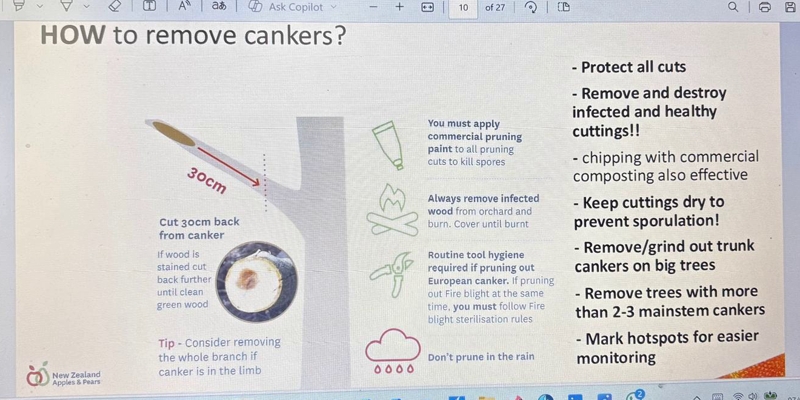
* Remove cankers from the trees/orchards; reduce inoculum
* Prune in the dry weather
* Prune to clean wood / protect the cuts
* Remove trees with mainstem cankers early
* Remove and destroy all cuttings (and fallen fruit)
* Monitor, especially young orchards:
* Hot spot marking / Canker champions / Canker bounty - reward orchard workers for identifying canker infections
The English Apple Man Comments: Much is covered in this week's Journal about Canker containment, there is much more about the influence of soil health and trials carried out in Mat's full presentation.
Click on link below and then scroll down to "A whole orchard approach to apple canker"
Click on: BAPL Technical Day 2026
 That is all for this week
Take care
The English Apple Man