The Journals give a weekly update on events in our English apple orchards, using pictures and video clips to follow seasonal activities and giving the consumer a level of detail not available from any other source.
All aspects of growing, harvesting, storage, grading, packing and marketing are included enabling consumers to understand the challenges English growers face in supplying our sophisticated market place.
While there is enthusiastic support for older traditional varieties from dedicated interest groups and supportive media, the English Apple Man will endeavour to explain why support for the mainstream commercial production of English apples is vital to a sustainable apple industry in this country, delivering recognised benefits to the health of our consumers while maintaining our diverse and beautiful countryside.
Varieties grown commercially are relatively few in number, when matched against the 2300 varieties on display at The National Fruit Collection at Brogdale in Kent and while there is an increasing desire by all parties to retain and where possible reintroduce the best of our heritage varieties, the sustainability of our apple acreage depends on no more than a dozen varieties.
However, that does not mean we should dismiss all the efforts of growers determined to maintain our many heritage varieties, we must support all our producers, whether they be small in acreage, selling directly to the consumer, or large scale operations growing a thousand acres or more and totally dependent on supplying our supermarkets.
The History of The English Apple Man is a story of a lifetime spent in the industry, as a boy straight out of school, then as a young man developing all the practical knowledge of growing and later taking on the management of the family fruit farm, then changing course to join the major supplier of English Apples in a technical role and finally becoming Technical Director with a responsibility for product and environmental safety, product quality, and technical innovation.
Now retired, The English Apple Man will bring his unique experience of the English apple industry to all who visit the English Apple Man website.
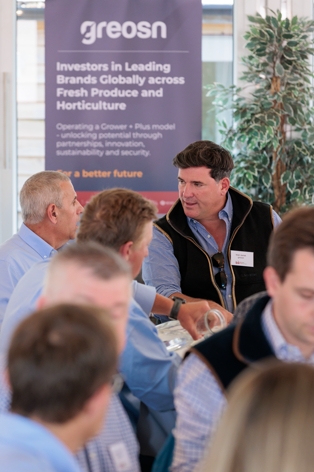
In this week's Journal The English Apple Man publishes some of the many excellent pictures taken by Martin Apps - Countrywide Photographic of this 'brilliant day' held at Greosn MANSFIELDS Highland Court Farm
Below: Greosn CEO Matt Jarrett
 Click on Groesn GROUP
Mansfields
UK's leading fruit grower, delivering a complete service in fresh produce since 1968.
Mansfields is the UK's leading fruit grower, dedicated to producing over 33,000 tonnes of premium quality fruit annually across 3,500 acres of farmland in Kent. Their diverse crop portfolio includes apples, pears, strawberries, cherries and plums, all cultivated with care and precision and processed through state of the art pack houses and storage facilities 365 days of the year.
Mansfields combines decades of horticultural expertise with a forward-thinking approach. They focus on building long-term partnerships while consistently upholding the highest standards in fruit production. It is their commitment to delivering a complete service in fresh produce that sets them apart - in addition to cultivating premium quality fruits, they also offer professional storage and packing services, 365 days a year.
Mansfields embraces innovative farming techniques and award-winning sustainable practices that extend harvest periods while minimising environmental impact.
Recognised with numerous accolades for their commitment to environmentally responsible strategies, their dedication to quality and sustainability positions Mansfields as a trusted name in British horticulture.
Below: Ali Capper with Award winning retailers from Tesco, Sainsbury, ALDI and LIDL
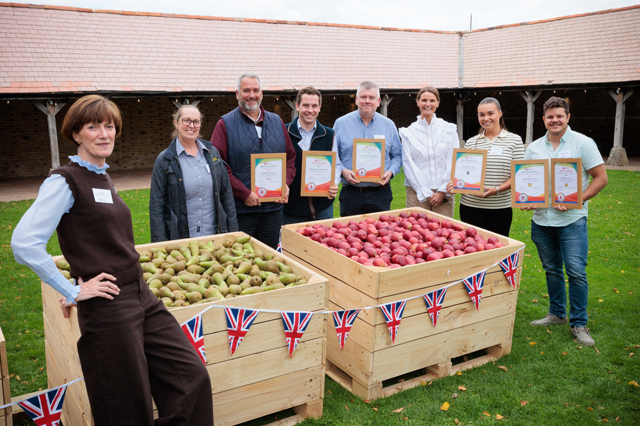
Another busy week, British Apples and Pears event at Mansfields Highland Court Farm and visiting a friend who lives where my Great Grandfather farmed in the 1800's and my Grandfather was born in 1876.
Below: Ali Capper with BAPL award winners from Tesco; Sainsbury; ALDI and LIDL at Mansfields Highland Court Farm
Award winning Retailers with Ali Capper at the annual presentation event on Wednesday 16th September 2026 held at 'The Night Barn' Highland Court Farm.
This was a very "full on event" and The English Apple Man will report the details over 2-3 weeks Journals.
British Apples & Pears Limited's (BAPL) Best British Apple Launch Award 2026 is now open for retailer planning.
As last year, this award will celebrate the most impactful, creative, and effective campaigns or activations that support the start of the British apple and pear season (September-November).
Whether it's a memorable TV advert, a standout in-store display, a sales-driving promotion, investment in sampling, engaging online storytelling, or a powerful multichannel campaign - we want to celebrate the very best examples of how retailers bring the new British season to life.
This year's harvest is an early one; Early clones of Gala were being harvested around mid August, 10 days before the normal harvest date. Pears and Bramley were under way before the end of August, Cox and mainstream Gala by the 1st of September.
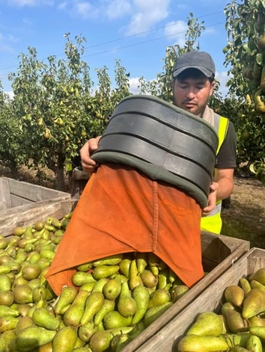
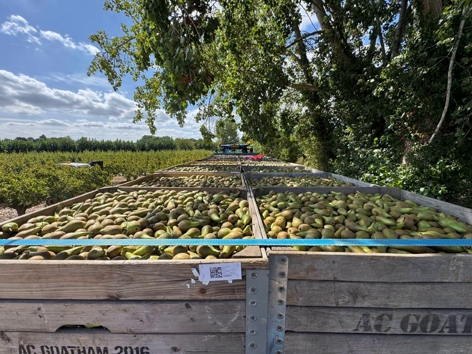
Below: 2026 Pear harvest at Britain's largest pear grower AC Goatham - thanks to Ross Goatham
I'm back - back after various hospital appointments, scans etc. and cataract operations which means I now have good distance vision and once I have had an appointment with my optician, new reading glasses should complete the new world of 20/20 vision!
September marks the start of the new British apple and pear season, with growers predicting a harvest that will deliver great flavour and good supplies throughout the season.
British Apples & Pears (BAPL) news report
Following crop assessments across orchards in England, growers expect overall production to be around the five-year average. While this year's crop is unlikely to be a record-breaker, growers say the eating quality could be among the very best for many years.
Young apples and pears are continuing to ripen in orchards across the UK. Growers have reviewed crops in their orchards and set out the following predictions for the coming season:
Good supplies for the season. Overall production is expected to provide retailers with dependable supplies of British apples and pears from the start of the season and well into 2027.
Great flavour and colour. Recent warm weather is expected to help fruit develop excellent sweetness, colour and aroma. Although temperatures have been high by UK standards, Britain's relatively temperate climate allows apples and pears to ripen more slowly than in many parts of continental Europe. This longer ripening period helps to develop the distinctive flavour and eating quality for which British fruit is renowned.
Natural variation across some orchards. Hail damage and cosmetic marks caused by spring frosts have affected fruit in some orchards. While the impact is limited, some retailers are already talking to suppliers about flexibility on cosmetic specifications for their core lines. Growers stress that these naturally occurring marks do not affect flavour, texture or eating quality.
Commenting on the grower predictions, Ali Capper, Executive Chair of British Apples & Pears Limited (BAPL), said: "We're expecting a reliable season for British apples and pears. Overall volumes are looking solid and, most importantly, we expect the fruit to taste exceptional.
"One of the advantages of growing fruit in Britain is that our climate allows apples and pears to mature gradually. The slower ripening in the UK also gives the fruit time to develop the sweetness, flavour and colour that consumers love. In addition, and very importantly, British growers have invested in precision irrigation, so despite the recent hot, dry weather, we are able to produce a very good crop.
"As with every harvest, nature has left its mark in some orchards. A small proportion of fruit has been affected by frost marks and hail, but these marks are purely cosmetic marks. The eating quality is just as good.
"We're encouraging retailers to recognise that natural variation is part of sustainable food production. If we're serious about reducing food waste, we need to value all fruit for how it tastes rather than expecting every apple to look exactly the same."
British growers are now preparing for harvest and working closely with retailers to celebrate the arrival of the new season from September onwards. With consumers increasingly choosing fresh, locally grown produce, the industry is looking forward to another strong season showcasing the quality of British apples and pears.
RELEASED: 3 AUGUST 2026
It's the time of the year when schools break up for the summer holidays and many families jet off for a summer break in the sun!!
 Well! No need to go abroad this year for the sunshine; as it's been persistent here this year!
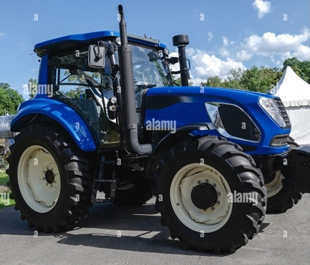
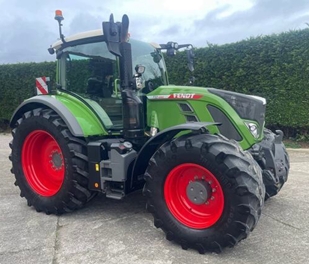
At the moment cereal farmers are hard at it; "this morning as I was waiting for the traffic lights to change in Hawkhurst High Steet, behind me, a very large New Holland tractor with a massive trailer loaded with straw bales. Then from the other direction a 'giant of a FENDT tractor with a large trailer carrying grain"
As a new season approaches, BIFGA organise a farm walk and in the orchard thinning is honing the quality of the 2026 crop. The heat has caused some sunburn issues on exposed apples, nevertheless some very heavy crops are expected.
On Tuesday 14th June The BIFGA summer farm walk visited Hadlow College and Boormans Fruit Farm a short drive from one to another!
At Hadlow College BIFGA members were able to view the new 'Thanet Earth Centre of Excellence' - this is a partnership between Hadlow College, Thanet Earth and Growing Kent and Medway.
Following the visit to Hadlow College the BIFGA group drove to the nearby Boormans Farm where members visited a number of orchards and in particular a new Magic Star orchard which is supported by a metal post and wirework system.
During the walk short stops for presentations by companies involved in the new plantation and further presentations by companies involved in recent building works and general running of the farm. All of these companies 'generously' contributed to the sponsorship of the event.
Below: L-R. John Breach-BIFGA Chairman, Katherine Speakman-BIFGA Secretary. Judi Perri-retiring BIFGA Secretary & Richard Bell-Biddenden Vineyard
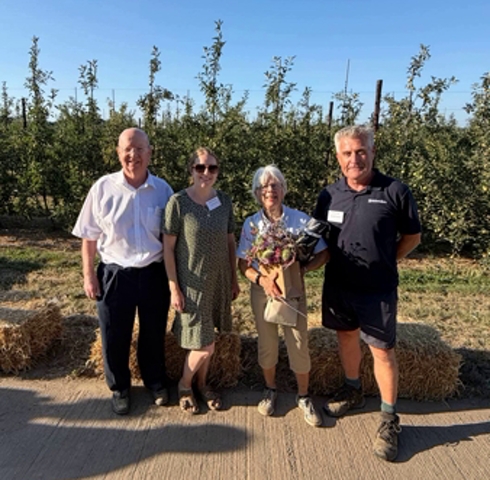 Following the farm walk the opportunity to thank long serving BIFGA Judi Perry for all her hard work over the last 34 years and thanks to a generous offer from Tom Barnes at Biddenden Vineyard of Gribble Ridge Sparkling Rose and Biddenden Sparkling Grape and Apple Juice, members were able to 'raise a glass' to Judi for a long and happy retirement.
The visit was rounded of with a Hog Roast followed by Strawberries and Cream.
My personal memories of Judi Perry go back decades. I have been astounded by her ability to create the content for many BIFGA meetings over the years, and the calm manner in which she delivered 'meeting after meeting' - by her side, lending support at many event days, her husband Mike.
I have known Mike for decades as well. as he was a scientist and central character at East Malling Research Station before the days of NIAB. Mike has been retired for somewhile, patiently waiting for Judi to join him in retirement!
I wish them well and much enjoyment in their (full) retirement together!
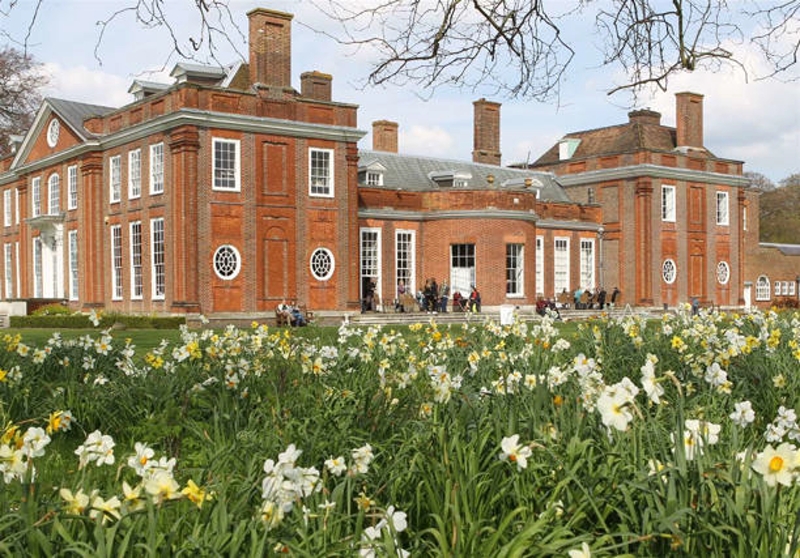
This week Fruit Focus was held at Bradbourne House at East Malling
Ironically Fruit Focus nearly always enjoys a warm sunny day. This year the weather was more than warm. coming in the heat wave conditions we have been coping with this summer.
Fruit Focus 2026 is the UK’s premier technical event for the fruit and vine industry, taking place on 8 July 2026 at Bradbourne House, East Malling.
Fruit Focus 2026 marks the 40th anniversary of the event and will feature a renewed focus on technical content tailored to the needs of the entire UK fruit and vine sector, including viticulture. The event provides a platform for knowledge exchange, innovation, and networking, serving the technical, purchasing, and professional development needs of fruit growers.
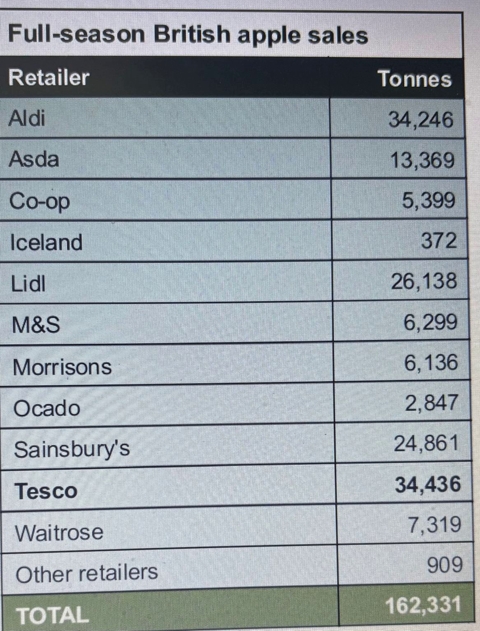
Nine months into the current British apple season, UK supermarkets have bought a record volume of British apples from growers, with the race for BAPL Retailer of the Year entering its final stretch....
BAPL announce sales to date of British apples - Tesco lead the way followed by ALDI and LIDL
British Apples & Pears Limited (BAPL), which represents UK growers, collates monthly data on purchases of British apples and pears by UK retailers. Analysis of the first nine months of the 2025/26 season (September 2025 to May 2026 inclusive) shows total British apple sales have reached 138,823 tonnes - the highest level for the same period in the last four seasons.
Whew! - the weather has been exceptionally hot and we oldies have been in survival mode, but
at last some relief as temperatures drop to a more acceptable level
Comparisons have been made with the summer of 1976 and I can remember that summer and the events around that time with great clarity!
It started in 1975 and carried on for another 5 years. My beloved father died in the spring of 1975. And that seemed to set in place a sequence of events which influenced my life until 1980.
In 1975 started growing Strawberries in 'Clovis Lande' polytunnels. These tunnels were 14feet wide and 65 feet long. The retention of the plastic covers achieved by digging a trench around the perimeter, and burying the plastic in the trench.
Over the next 50 years that simple format has evolved into very sophisticated growing systems with automatic venting central to the format.
Recently The English Apple Man attended a really enjoyable evening where Chris and Sheena Levett told the story of where and when apples arrived in Kent. Chris & Sheena have been friends for many years, as we both farmed in Hawkhurst, one on each side of the village.
The Venue: Ticehurst Village Hall. 'Ticehurst Talks' are held there raising funds for refurbishment of the venue, which has a notable history. Peter Reeves Chaired the event.
Peter farms in Ticehurst on the edge of the Bewl Bridge reservoir, his original farm and farmhouse is now well under the reservoir.
Ticehurst Talks
Thursday, June 11th 2026 - CHRIS and SHEENAGH LEVETT - The History of Apples
Is it CRUNCH TIME for the Kent apple industry?
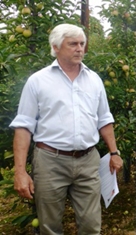 Apple growers Chris and Sheenagh presented a talk on the history of apple growing in Kent, and answer the question - "Why are so many apple orchards disappearing?"
Have you ever wondered why Kent became known as the Garden of England? What about the stories behind little known apple varieties such as 'Cow's Snout' or 'Lady Sudely' or even the the ancient practice of Wassailing?
The English apple industry has had its highs and lows for centuries and has had to adapt to huge changes. We shall follow the story from 4000BC to the present day, and peek into the future for the Kent apple into the 21st Century.
EAM Addition It seems that at some point, around 50 to 65 million years ago, the apple ancestor separated from its Rosaceae cousins on the evolutionary pathway. By duplicating almost all of its genome, apples now have very different fruit characteristics to related plants, such as peaches, raspberries, and strawberries.
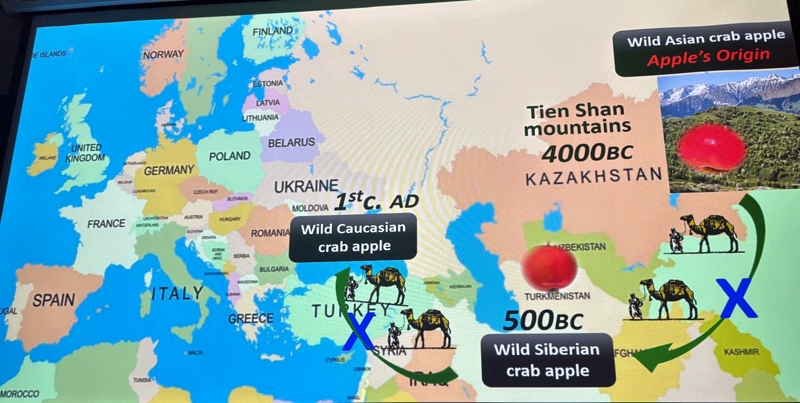
Below: The apple originated in the Tien Shan Mountains in Kasakhstan close to China 4,000 years ago. Over the centuries the apple made it's way Westwards via the 'silk road' the seeds spread by the hooves of camels and horses until it reached the the valley of the Tigris and Euphrates about 3,800 years ago where the discovery of budding and grafting onto a rootstock enabled propagation and multiplication of a distinct variety.
So sorry to my readers my Journal for 12th June was scuppered!
 On entering the website ready to write the Journal, the password entry point would not allow me in!
Having tried unsuccessfully several times, I tried my administrator but could not make contact!
So no Journal!!!!
As we enter June, a plethora of pests launches into 'action' in our apple and pear orchards!
Mowing, Tying tree tops, thinning, dealing with 'early season pests' - Rosy apple aphid and Pear sucker are high on the list. But spraying to control apple scab and mildew are a vital part of our routine 'pest control'
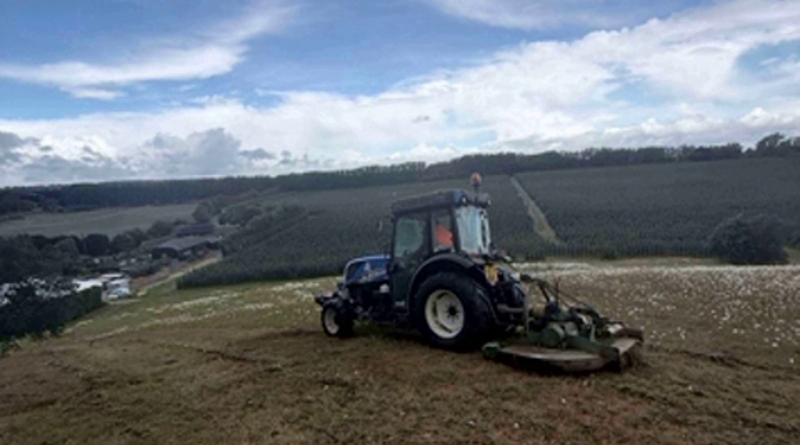
Below: AC Goatham & Sons - Tractor Driver mowing looking down on orchards at Gore Farm Upchurch
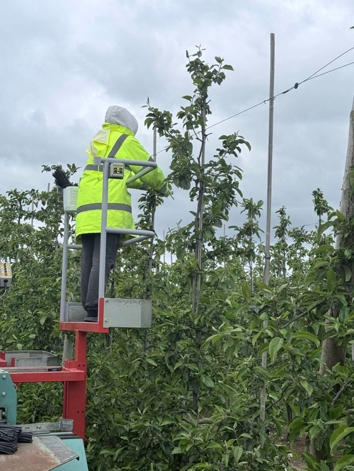
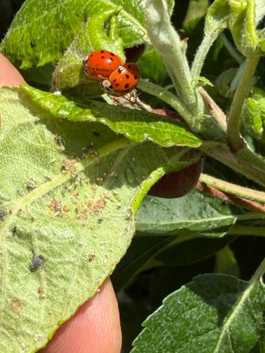
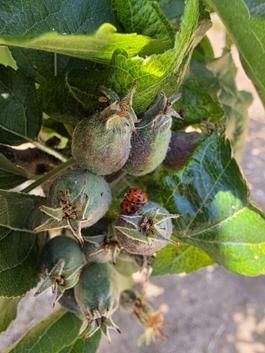
Operative at AC Goatham tying the tops of trees in one of their orchards. Trees are kept at 3m high and right. Ladybirds making love while feeding (predation) on rosy apple aphids
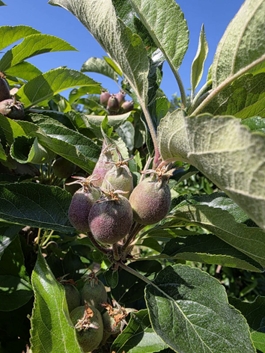
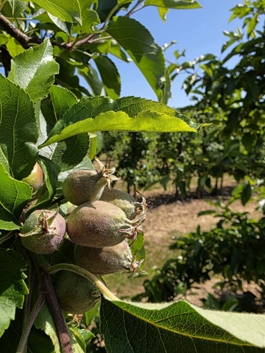
Below: Left and right. fruitlets are now growing beyond the stage where fruit thinning sprays are effective (8-12 mm)
The English Apple Man Comments
I intended to deal with these "Pesky Pests" but scrolling back a year, I found a comprehensive version which matches well this time of year so instead of writing it all again, this week I draw readers attention to ................
Organic apple production is a challenge but Paul Ward has not only succeeded but built a large business over a 30 year period.
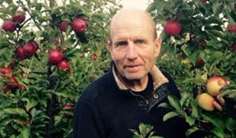 I first met Paul Ward back in 1996, just two years after he launched his organic business. With my Fruition Group colleague Graham we visited Paul hoping to arrange a supply of Organic apples to Waitrose who were a 'high profile' customer with a determination to support 'home grown organic produce'
Our relationship has continued and I have watched Paul build his business into the biggest organic apple farming business in the UK with 110 hectares of organic production. Mole End Farms is by nature 'a labour hungry operation' with circa 50 personnel (Trustees)
History
Mole End Farms Ltd was the brainchild of Paul Ward and Sara Rowan who, in 1994, decided that the time was right for a complete career change. Passionate believers in organics, they bought Mole End Farm in Chart Sutton and became the sole directors of Mole End Farms Ltd. This was followed by the purchase of Hartley Lands Farm at Cranbrook which they proceeded to convert to Soil Association organic standards and gradually over the years further holdings and organic orchards have been added.
In June 2017, after a long period of thought, deliberation and soul searching, Sara Rowan decided that the time was right to leave the business to pursue new challenges. Sara is an accomplished artist and had several commissions that she had been asked to do - she also hoped that weather permitting, she would have more time to ride her beloved Harley!
Mole End Farms grows top fruit organically on approximately 110 Hectares across 8 sites in Kent at Cranbrook, Marden, Goudhurst, Sandhurst and Chart Sutton. We grow, store, pack and market our own produce.
Mole End Farms is the biggest Organic Top Fruit Farm in the UK
WOW, The weather's turned 'ever so hot all of a sudden;
What's going on in our apple orchards?
I start with a caterpillar invasion. A call from my grand daughter alerted me to an invasion of caterpillars in the Espalier Apple trees in my son' garden. Now I have been growing apples for more than 60 years and I don't remember seeing these little 'critters!
Of course, at my age the memory is not so good!
In truth as our industry uses less chemicals, pests which would have been removed by a green cluster 'broad spectrum' insecticide would rarely be seen, now emerge...........